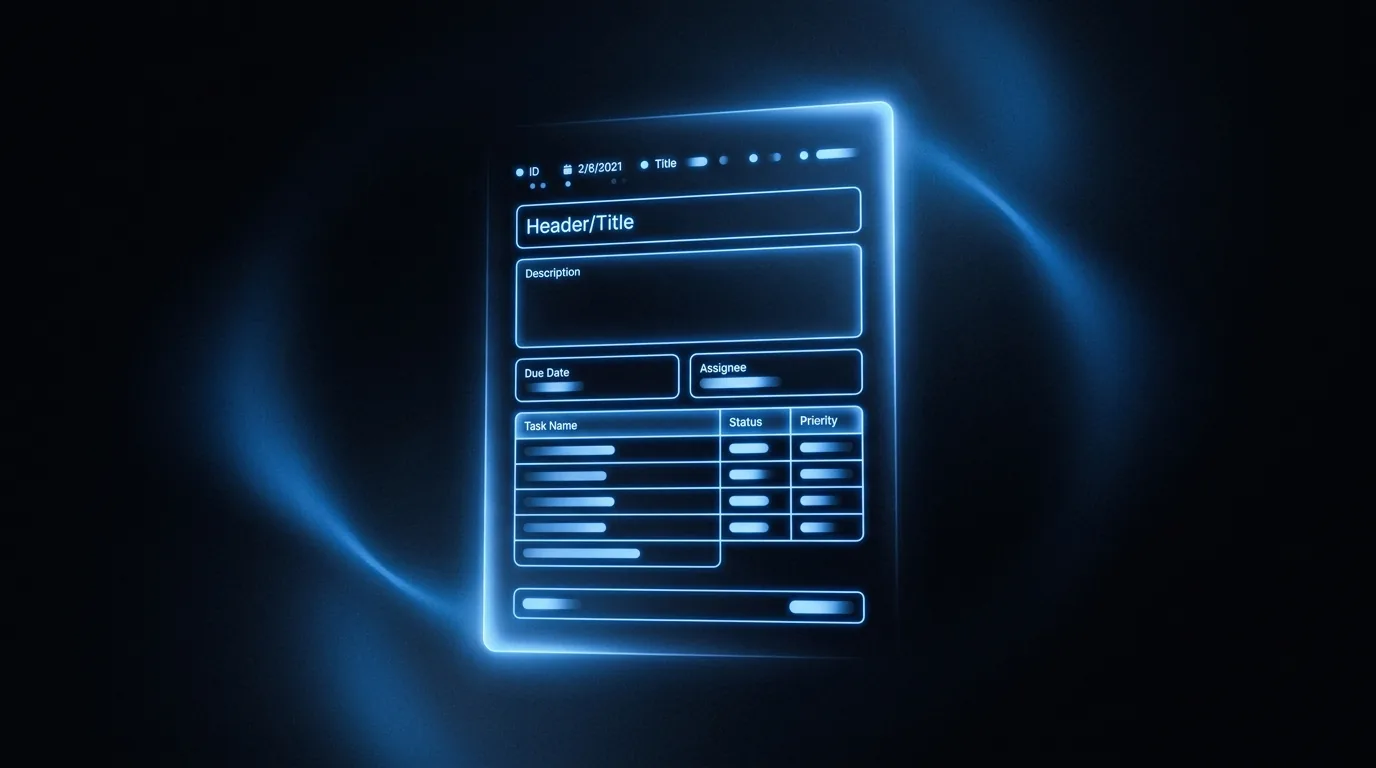

The structure of a product page that ranks
A product page that ranks follows a strict semantic architecture: a unique H1 with the product name, a structured specifications block, an editorial description, and a reviews section. Google and generative engines read this hierarchy to understand what the page is about. Disorganize it, and you lose readability for machines and humans alike.
The H1 contains the exact product name, ideally enriched with its main attribute (brand, model, format). Technical specifications live in a table or a definition list, never buried in a marketing paragraph. This separation is not cosmetic: it lets crawlers extract each attribute in isolation, and lets LLMs reconstruct a factual answer.
A hierarchy with no skipped levels
Respect the order H1 then H2 then H3, without skipping a step. A section title that jumps straight from H1 to H4 blurs the document tree. Structure recurring blocks — description, specifications, shipping, warranty, reviews — with consistent H2s across the entire catalog. This consistency also helps your category clusters reinforce one another, exactly the way a solid content strategy structures a SaaS site.
Unique content, your only real lever
Duplicate content kills product pages. When you publish the manufacturer's description verbatim, you compete head-on with every reseller doing the same thing — and Google has no reason to pick you. Original content is the only lever your competitors cannot copy.
Rewrite each description starting from real-world use. What does this product solve? For whom? In what context? Add what the supplier description will never tell you: care tips, compatibilities, common buying mistakes, a comparison with an alternative in your catalog. These experience signals are what differentiate a page and feed the answers of AI engines.
Customer reviews, free unique content
Verified reviews are original content produced by your customers. They enrich the page with natural vocabulary, real questions, and long-tail terms you would never have written yourself. Display them in HTML, not in a third-party JavaScript widget invisible to crawlers. The same logic applies to purchase-decision content: good BOFU content answers objections right before conversion, and a product page is, by nature, a BOFU page.
According to the Ahrefs analysis of 75,000 brands (Dec. 2025), off-site brand mentions correlate more strongly with AI citations than Domain Rating (0.218). Unique content and brand authority weigh more than raw domain power.
Product schema, the essential signal
Product schema is the markup that turns a page into usable data. It explicitly declares the name, price, availability, average rating, and characteristics of the product in a format engines understand without interpretation. Without it, you leave Google to guess; with it, you dictate the answer.
In practice, this markup unlocks rich snippets: rating stars, price, and stock status displayed directly in the results. These elements increase click-through rate at equal position. But the benefit goes beyond classic SEO. FAQPage schema, when it accompanies a page, is a strong signal for AI Overviews, which favor content structured as questions and answers.
The properties you should never forget
The basic triptych. The name must match the H1, the brand must be explicit, the description must reflect your unique text.
Declare the price, the currency, and the stock status. This is what feeds the price and availability rich snippets.
Connect your real reviews. Never invented ratings: Google penalizes markup not visible on screen.
These identifiers tie your product to manufacturer reference databases and strengthen the trust of comparison engines.
The GEO stakes of product pages
The visibility of a product page is no longer decided on the SERP alone. More than half of Google queries trigger an AI Overview, and buyers now query ChatGPT — more than 900 million weekly users — to compare before buying. If your page is not usable by these engines, it is invisible at the decisive moment.
The first non-negotiable condition: server-side rendering. LLMs do not execute JavaScript. A page whose price, specifications, and reviews are injected only client-side is, for a generative engine, an empty page. SSR or static HTML is essential for ChatGPT and Perplexity to read and cite your product.
Becoming a citable source, not just a result
| Criterion | Page optimized for SEO only | Page optimized for SEO + GEO |
|---|---|---|
| Rendering | Often client-side | Server-side, static HTML |
| Content | Supplier description | Unique text + citable passage around 150 words |
| Structured data | Basic Product | Product + FAQPage + visible reviews |
| Visibility | Classic SERP position | Cited in AI Overviews and ChatGPT |
Note a key imbalance: only 11% of domains are cited both by ChatGPT and by Google's AI Overviews. In other words, dominating one surface guarantees nothing on the other. A product page optimized for both captures demand that almost all of your competitors let slip away. This dual presence, by sector, is part of our sector expertise.
The 6-action optimization plan
Optimizing a catalog is not done in one pass. Prioritize high-potential pages — top sellers, high margins, strong search demand — then roll out the method product by product.
Identify the pages reusing the supplier description. These are your absolute rewriting priorities.
Open each description with a self-contained block of around 150 words answering the dominant purchase question. This is the format LLMs extract.
Enforce a consistent H1-H2-H3 template: description, specifications, shipping, warranty, reviews. No skipped levels.
name, offers, aggregateRating, sku. Add a FAQPage with the real purchase questions.
Disable JavaScript and reload the page. If the price and specifications disappear, fix the rendering before anything else.
Pull them out of invisible third-party widgets. Customer content readable by crawlers and by AI.
Before investing, measure the expected gain. Our SEO/GEO ROI Calculator estimates the return of a catalog optimization based on your traffic and margins, to prioritize the projects that truly pay off.
Request a free GEO audit. We analyze the rendering, schema, and citability of your catalog, and identify the pages slipping away from you on ChatGPT and AI Overviews.
Questions fréquentes
Why aren't my product pages ranking on Google?+
In 80% of cases, the problem is duplicate content: you publish the supplier description verbatim, the same one found on dozens of other sites. Google has no reason to favor you. Add an original description, structured specifications, and real customer reviews to differentiate the page.
Is Product schema mandatory for e-commerce SEO?+
It is not mandatory but nearly essential. Product markup lets price, availability, and ratings appear as rich snippets in the results, which increases click-through rate. It is also a strong structured signal used by AI Overviews and generative engines to understand and cite your products.
How many words should a product description be?+
There is no magic threshold. Aim for a description rich enough to cover use cases, benefits, and specifications, generally between 300 and 600 words for a high-stakes product. What matters is that a self-contained passage of around 150 words directly answers the most common purchase question.
Can product pages be cited by ChatGPT?+
Yes, provided they are server-side rendered as static HTML, because LLMs do not execute JavaScript. A clear, structured page with specifications and Product schema becomes a usable source that generative engines can extract and cite for a comparative query.