
What an SEO brief is really for
An SEO brief removes the randomness from content production. Before writing, it sets what determines ranking: intent, structure, semantic coverage, internal linking. The writer no longer improvises, they execute a validated plan.
Most content that never ranks suffers from the same flaw: it was written without a brief. The writer guessed the intent, chose an angle by feel, forgot half the questions readers ask, and skipped internal linking. The result is a decent text that answers no precise query.
The brief reverses this logic. It starts from the real SERP, not from a topic idea. Before writing, you observe what Google already ranks, what competitors cover, what users ask for in addition. The brief encodes these observations into actionable guidelines.
The brief is also a scalability tool
A brief template lets you delegate writing without losing quality. Three different writers following the same brief produce three texts consistent with your SEO and GEO content strategy. That is the condition for producing volume without diluting the editorial line.
The brief also serves as a checkpoint. Validation happens against the brief, not against a subjective impression. Either the content ticks the criteria, or it goes back for correction. This objectivity saves review cycles.
The eight blocks of the template
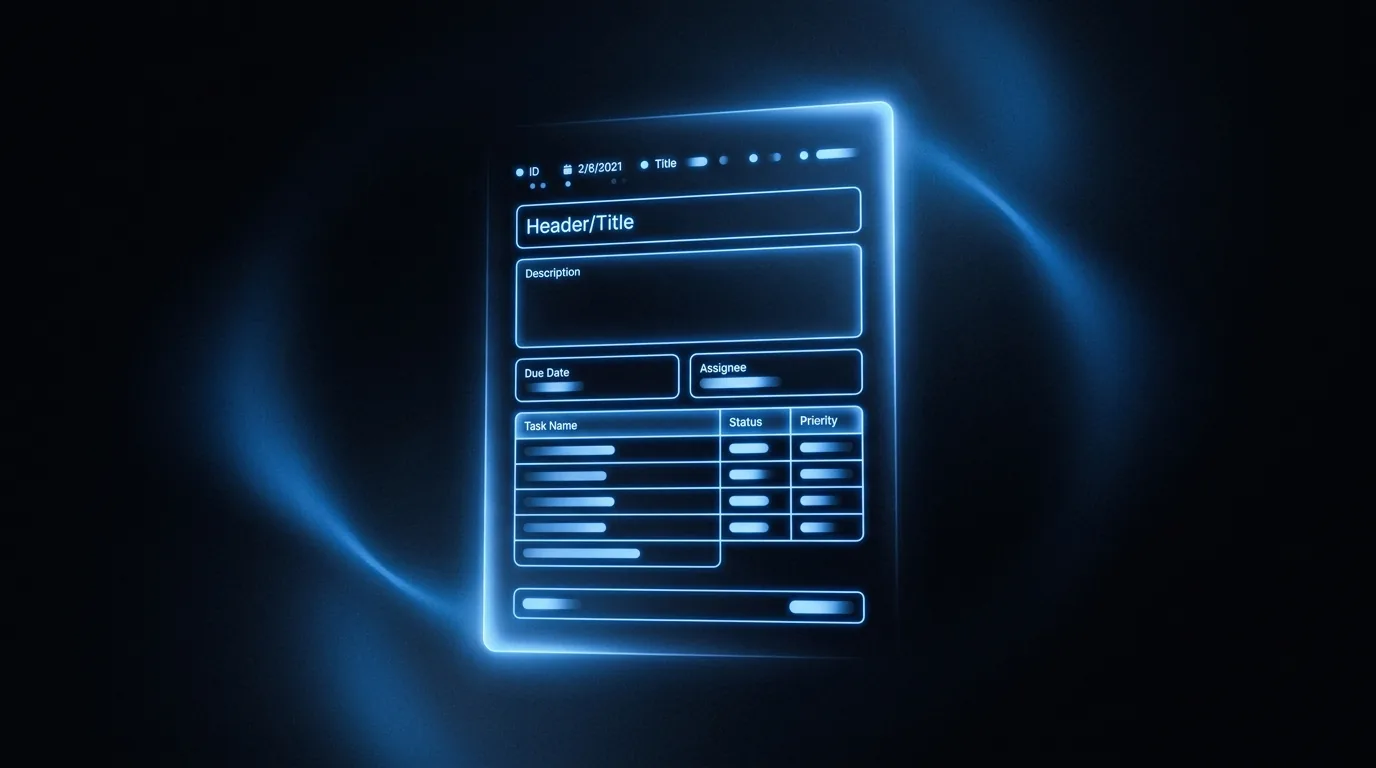
An effective SEO brief fits on one page and is built from eight blocks. Each answers a precise question that the writer would otherwise answer in your place, and often poorly.
Why this content exists. Targeted position, commercial intent (TOFU, MOFU, BOFU), expected conversion. An article without a business objective is a cost, not an asset.
The primary keyword, two to four secondary ones, and above all the dominant intent: informational, commercial, or transactional. Intent dictates the format as much as the topic.
Who the text addresses, their level of expertise, their real question. The same keyword is handled differently for a beginner and for an expert.
The full outline in H2s and H3s, derived from the content already ranking. The writer receives a framework, not a blank page.
The real questions extracted from the SERP and the suggestions. They feed the subheadings and the FAQ. They are the raw material of GEO.
The mandatory inbound and outbound links, with their anchors. Internal linking is too strategic to be left to the writer's improvisation.
Tone, target length, words to ban, level of proof expected, authorized sources. The brand voice lives here.
The binary review checklist. Keyword in the title and the H1, intent covered, PAA questions handled, links placed, citable passages present.
The method to fill out each block
Filling out a brief is not improvised. The method always starts from the SERP, never from your intuition about the topic.
Derive the intent from the SERP, not from the keyword
Type the keyword into Google and read the top 10. The dominant format reveals the intent. If Google ranks comparisons, the reader is comparing. If it ranks tutorials, they want a step-by-step guide. Match the majority format before trying to differentiate. You cannot rank for an intent you do not serve.
Build the Hn structure by aggregation
Open the first three to five results. Note their H2s. The headings that appear everywhere are required passages: they answer an expectation Google has already validated. The headings absent from competitors but relevant are your differentiating angle. Your outline aggregates the common base and adds the angle that sets you apart.
Extract the real questions
The People Also Ask block, related searches, and autocomplete suggestions give the real questions. Use them as is: they are the exact phrasings that users and LLMs use. They become your question subheadings and your FAQ entries.
Wire the internal linking before writing
Internal linking is not added after the fact. Define in the brief the link to the pillar page, the links to sibling articles in the same cluster, and the exact anchor for each. This discipline is what structures a coherent semantic silo rather than a stack of isolated articles. For the fine logic of anchors and link depth, SEO internal linking deserves dedicated framing in every brief.
But 47% come from positions 5 to 10. A solid brief targets the top 10, not just the first place: the 5-10 zone remains largely citable by AI.
Adapting the brief for GEO
Adapting a brief for GEO means adding a ninth block dedicated to citable passages. Classic SEO targets a ranking of links. GEO targets the extraction of passages by AI models. The brief must instruct both.
The central rule fits in one sentence: each section opens with a direct answer in one or two sentences, then develops. AI models extract self-contained passages. A paragraph that starts with context before answering is not citable. A paragraph that answers right away is. The brief must impose it section by section.
The GEO guidelines to write into the brief
| Criterion | Classic SEO brief | GEO-adapted brief |
|---|---|---|
| Section opening | Free-form introduction | Direct answer in 1-2 sentences |
| Length of key passages | Not specified | ~150 self-contained words |
| FAQ | Optional | 4 PAA questions, FAQPage schema |
| Technical rendering | Barely considered | SSR or static HTML required |
| Objective | Position in the SERP | Citation in AI answers |
Three guidelines are non-negotiable in a GEO brief. First, the length of citable passages: aim for around 150 words for the key answers, the window that models pick up best. Next, the marked-up FAQ: four questions drawn from People Also Ask, in FAQPage schema, which form a strong signal for AI Overviews. Finally, the technical reminder: LLMs do not execute JavaScript, so the content must be rendered server-side or in static HTML, otherwise it stays invisible to AI crawlers, no matter how much care goes into the text.
Why this changes production
With more than half of Google queries now triggering an AI Overview, a brief that ignores citability produces content that is half blind. The writer optimizes for a ranking the reader will sometimes never see, for lack of a click. The GEO block puts production back on the right ground: being picked up in the answer, not just appearing beneath it.
The mistakes that ruin a brief
The first mistake kills the brief before it serves any purpose: writing it after choosing the angle. The brief starts from the SERP, not from an idea. Reversing the order amounts to justifying an intuition instead of serving a real intent.
The second mistake is over-specification. A brief is not a fill-in-the-blanks text. If it dictates every sentence, it stifles the writer and produces mechanical content. It sets the frame, the framework, and the non-negotiables, then lets expertise express itself in the paragraphs.
The third mistake is forgetting internal linking. An article published without inbound links from existing pages stays orphaned. The brief must impose the linking upfront, otherwise no one will come back to put it in place.
The fourth mistake, specific to 2026, is briefing for SEO alone. Without a GEO block, content can rank without ever being cited by AI. Yet only 11% of cited domains are cited by both ChatGPT and AI Overviews: targeting a single channel leaves the other empty.
You can speed up the rollout with our GEO Audit Templates Pack, which includes a ready-to-duplicate brief template with the GEO block already calibrated.
Request a free GEO audit. We measure your real share of voice in ChatGPT, Perplexity, and AI Overviews, and we identify the passages to fix.
Questions fréquentes
What is an SEO content brief?+
An SEO brief is a document that guides the writer before writing begins. It sets the target keyword, the search intent, the angle, the heading structure, the questions to cover, the internal links, and the length. It turns a ranking target into a precise, repeatable writing plan.
What are the essential elements of an SEO brief?+
Eight blocks: the business objective, the keyword and its intent, the audience, the Hn structure, the questions drawn from People Also Ask, the internal linking, the editorial guidelines, and the validation criteria. In 2026, you add a block dedicated to citable passages for GEO.
How do you adapt an SEO brief for GEO?+
Add citability guidelines. Each section must open with a direct answer in one or two sentences. Plan for self-contained passages of around 150 words, an FAQ marked up in FAQPage schema, and factual answers that an LLM can extract without depending on the surrounding context.
How long does it take to write an SEO brief?+
Between thirty minutes and two hours depending on the competitiveness of the keyword. A brief for a simple query fills out quickly with a template. A brief for a competitive query requires a fine analysis of the SERP, the People Also Ask, and the content already ranking.