
AI & Visibility for Insurance
An insurance agency that's excellent on the ground can stay invisible when a prospect asks ChatGPT which insurance to choose. We work all three levers: AI visibility, an agent that qualifies and books, and automations that unload the agency.
Optimized to be cited in
What follows is written and checked by people.
Diagnosis, content, technical work, reporting: the same small team follows every step, from the first audit to the monthly report. No anonymous subcontracting, no unreviewed generated content.
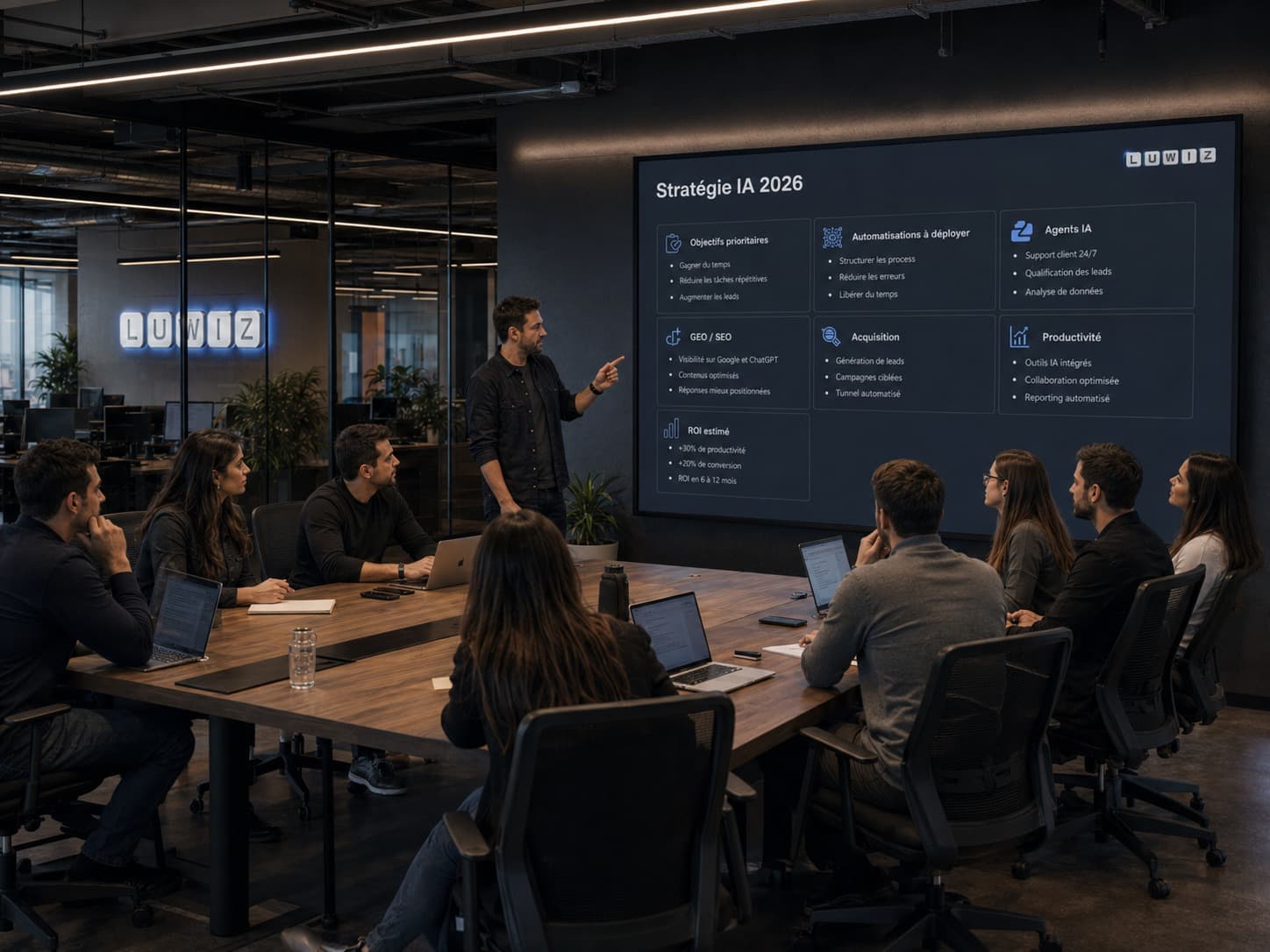


An insurance agency can be excellent on the ground — competitive rates, responsive customer service — and still be completely invisible when a local asks ChatGPT which insurance to choose nearby. The challenge is no longer just ranking well on Google: it's being recommended by AI, qualifying every incoming prospect, and unloading the agency from chasing and paperwork. We work these three levers together.
Why insurance follows its own rules
The insurance market is locked down by national brands with massive ad budgets and by comparison sites that capture transactional intent. A local agency or broker will never win "cheap car insurance" against a comparison site. But that's not the right battleground. The serious prospect isn't only after the lowest price: they want an agency that's well-priced and capable of genuine, local customer service. That very shift opens a gap.
Because the way people search has changed. Before walking into an agency, the prospect asks ChatGPT, Perplexity or Google AI Overviews for "the best insurance in [city]", "which insurance for a young driver", "do I need professional liability for my business". These answers cite sources — and your agency can be one, or not. That's where the first impression is now made, long before the quote.
of French people already use a generative AI to search (Arcep/Arcom 2025)
AI visibility, an agent that qualifies and books, back-office automation
getting recommended on "best insurance in [city]" where the big brands stay generic
Proof: AXA Assurance in Orléans, recommended by AI
Two AXA agencies in Orléans, excellent on the ground — well-priced, competent customer service — yet absent when a local asked an AI for advice. A prospect writing to ChatGPT "I'm looking for the best insurance in Orléans, well-priced and above all with competent customer service" never saw them appear in the answer.
What we did, concretely: optimized the agencies' Google Business Profiles (reviews, responsiveness, categories), produced citable local content on "Orléans insurance price + service", and aligned the NAP (name, address, phone) across branches so engines unambiguously identify one trusted local brand. Result: today, for "best insurance in Orléans", it's these agencies the AI recommends.
An agency can be objectively the best in a city and lose every prospect who now researches through an AI. Local AI visibility isn't a bonus: it's the new first contact.

Lever 1 — Being recommended by AI (GEO / AEO)
When a prospect asks an AI which insurance to choose in their city, the generated answer relies on precise signals: clean, active Google Business Profiles, a consistent NAP, and above all local content that answers exactly the question asked — "price + service". GEO applied to insurance means structuring that content in clear, self-contained passages, each handling a real question: "what's the best car insurance in Orléans", "how to choose home insurance", "which insurance for a tradesperson".
AEO rounds out the setup on Google: AI Overviews and featured snippets on "home insurance coverage" or "car insurance excess" are as many chances to appear as a source. The same well-structured page serves Google and AI — one piece of content, two visibility surfaces.
Optimized Google Business Profiles
Reviews, responsiveness, categories, consistent NAP across branches. The foundation of local citability, as on the AXA agencies in Orléans.
Local 'price + service' content
Pages that answer "best insurance in [city]" on the two criteria that truly matter to the prospect.
Product guides
Auto, home, health, professional: citable content per product, structured to be quoted as-is by the AI.
Citable coverage FAQ
Excess, exclusions, limits, waiting periods: the questions asked to AI, handled as self-contained, sourced blocks.
Lever 2 — An AI agent that qualifies and books
A prospect landing on your site at 9pm with a question about their car insurance won't necessarily call back tomorrow. The AI agent responds immediately — on the site, on WhatsApp or by phone — qualifies the need (auto, home, professional, health), gauges urgency, routes to the right product, then offers an appointment with an advisor or launches a quote request. The advisor no longer gets a bare "call me back": they get a pre-framed file.
The rule is strict and non-negotiable in insurance: the agent qualifies and routes, it never advises. No regulated recommendation, no contractual commitment is produced by the AI. All advisory and underwriting value stays human. The agent absorbs the first level — triage, qualify, book — so the advisor spends their time on what matters: relationship and underwriting.
| Moment | Without an AI agent | With the LUWIZ agent |
|---|---|---|
| After-hours request | Lost or uncertain callback | Qualified and appointment offered immediately |
| Nature of the contact | 'Call me back', no context | Need, product and urgency already identified |
| Advisor's load | Triages requests themselves | Only receives qualified files |
| Regulated advice | — | Always human, never delegated to the AI |
Lever 3 — Automating what wears the agency down
An insurance agency loses a huge amount of time on three repetitive tasks: chasing unsigned quotes, reminding contract renewals before they lapse, and running after a file's documents. These are exactly the three automations we deploy for the sector. They run on infrastructure we host, with systematic human validation on everything sensitive — letters, contractual documents, regulated exchanges.
Quote chasing
Automatic J+2 / J+5 / J+10 sequence by WhatsApp and email on unsigned quotes, stopped on signature. +15–25% conversion [TO VALIDATE].
Renewal reminder
Detection of contracts nearing renewal, personalized message before the deadline to secure the renewal and offer a review.
Document collection
Personalized checklist, upload link, automatic chasing of missing documents, notification when the file is complete.
Letter drafting (HITL)
Letters generated in the agency's template, always human-validated before sending. −70% drafting time [TO VALIDATE].
We don't sell a tool, we sell a result: fewer quotes left dormant, fewer renewals slipping away, fewer incomplete files. The infrastructure and intellectual property stay at LUWIZ — you get the time back.

Agency, broker, network: three distinct realities
A local network agency (AXA, Allianz, MAAF type) needs local authority and AI citability on its city, with NAP consistency across points of sale. An independent broker competes on expertise and advice: their content must demonstrate real mastery per product and per profile. A network or group runs several agencies and needs a coherent architecture that avoids cannibalization between points of sale. We never impose a generic model: we start from your status, your area and your products.
The difference between a generic approach and the LUWIZ approach
Most providers sell an insurance agency a site and a bit of SEO, then stop. That approach ignores the sector's real mechanics: competition from national brands, the weight of local, the shift of search toward AI, and the back office suffocating advisors. Here's what separates an ordinary service from support built for insurance in 2026.
| Criterion | Generic approach | LUWIZ approach |
|---|---|---|
| Visibility | Google positions only | Google + AI recommendation on 'best insurance in [city]' |
| Incoming prospects | Raw, unqualified form | Agent that qualifies product and urgency, then books |
| Back office | Not handled | Quote chasing, renewal reminders, document collection automated |
| Regulated advice | Vague | Always human, the AI never advises on a contract |
| Measurement | Positions | Quotes, appointments, recovered renewals, AI share of voice |
Where to start: the first insurance levers
Reviews, responsiveness, categories, consistent NAP across branches. The most profitable foundation of local citability.
Local pages that answer "best insurance in [city]" on the two decisive criteria, citable by AI.
An agent that triages auto / home / professional, gauges urgency and books the appointment — without ever giving regulated advice.
Chasing unsigned quotes, renewal reminders, document collection — with human validation on the sensitive parts.
Concrete GEO use cases in insurance
GEO turns mundane questions into recommendation opportunities. "What's the best insurance in Orléans", "do I need external borrower's insurance", "which cover for a water leak": every question asked to an AI generates an answer that cites sources. Being cited means appearing at the exact moment the prospect is researching, with no ad or comparison site between you and them.
Concretely, we build content clusters covering the full journey, from first question to quote. A citable passage is a self-contained block that fully answers a question without depending on the rest: it names the product, gives the direct answer, then backs it up. Handling "how a car insurance excess is calculated" or "which insurance for a sole trader" as one complete, factual, sourced block is exactly what ChatGPT can extract and quote as-is. That writing discipline separates content merely published from content actually recommended.
Local choice queries
"Best insurance in [city] price + service": the query where a local agency can beat generic brands.
Per-product questions
Young-driver auto, tenant home, professional liability: citable answers on precise, qualifying needs.
Coverage FAQ
Excess, exclusions, waiting periods, limits: the questions massively asked to AI, handled as self-contained blocks.
Coverage comparisons
What a contract really covers, without the jargon: the trust content AI favors.
The KPIs to track in insurance
Good steering isn't measured in Google positions, but in commercial results and time recovered. The reference KPIs are the number of quote and appointment requests generated by visibility, your agencies' citation rate in AI answers, and the measurable effect of automations: converted chased quotes, renewals recovered before lapse, files completed faster. These indicators tie each lever directly to a result, where position tracking stays a misleading intermediate signal. Our dashboard ties each query and each automation to a measurable business result.
qualified requests generated, the reference business KPI
how often your agencies are recommended in generative answers
quotes chased, renewals secured, files completed without manual effort
Common mistakes of insurance agencies online
The first mistake is fighting comparison sites and national brands on price queries — a lost battle against unlimited budgets. The second, quieter one, is the total absence from AI: while locals ask ChatGPT which insurance to choose, most agencies stay invisible from those answers, as the AXA agencies in Orléans were before our work. The third is letting a valuable advisor drown in quote chasing, renewal reminders and document collection — time that should go to advice and underwriting. Avoiding these three traps often unlocks progress that years of misdirected web work never produced.
Capture "best insurance in [city] price + service" queries instead of fighting comparison sites on price.
Structure content and local profiles to be recommended by ChatGPT and Perplexity, where competitors are absent.
Have the agent absorb the first level and automate the chasing, to refocus the human on advice.
Tie each lever to the quotes, appointments and renewals actually generated.
Our approach: the LUWIZ Method applied to insurance
No improvised actions month after month. Every engagement follows the four steps of the LUWIZ Method: Diagnosis (audit of Google + AI visibility, GBP profiles, back office), Foundation (clean local profiles, citable "price + service" content, consistent NAP, schema), Authority (E-E-A-T, reviews, qualifying agent, business automations), Steering (measuring quotes, appointments, renewals and AI share of voice). You always know where you stand and why — and you tie every euro invested to a concrete result, like the AXA agencies in Orléans the AI now recommends.
The LUWIZ Method — 4 steps

Diagnosis
AI & SEO visibility audit, mapping of target queries across Google, ChatGPT, Perplexity, Gemini and Claude.
Foundation
Technical structure and citable content: JSON-LD schema, llms.txt, ~150 word passages, siloed architecture.
Authority
E-E-A-T signals, external mentions and citations, internal linking that consolidates your topical authority.
Steering
AI share of voice measurement, monthly reporting and continuous optimization of your citations.
Frequently asked questions
Yes, and it already happens. For AXA Assurance in Orléans, a local asking an AI for 'the best insurance in Orléans, well-priced and with competent customer service' was recommended the agencies we worked on. Two AXA agencies excellent on the ground yet absent from AI answers: we optimized their Google Business Profiles (reviews, responsiveness), produced citable local content on 'price + service', and ensured NAP consistency across branches. That structured, localized content is what the AI cites.
On choice queries, not on the brand queries of the major insurers. A prospect asks 'best insurance in Orléans price + service', 'which car insurance for a young driver', 'do I need professional liability for my business'. These questions are asked to Google AND to generative AI, often before any human contact. That's where a local agency becomes visible while its competitors stay absent from those answers.
It responds 24/7 on the site, WhatsApp or by phone, qualifies the need (auto, home, professional, health), gauges urgency, routes to the right product and directly offers an appointment with an advisor or a quote request. It never gives regulated advice or a contractual commitment: it triages, qualifies and books. The advisor receives a pre-framed prospect instead of a bare 'call me back'.
Three above all: chasing unsigned quotes (a J+2 / J+5 / J+10 sequence, +15–25% conversion [TO VALIDATE]), automatic reminders of contract renewals before they lapse, and collecting a file's documents (checklist, upload, chasing missing paperwork). It all runs on infrastructure we host, with human validation on everything sensitive.
No, it protects them. An insurance advisor adds value on advice, underwriting and relationship. Losing them to request triage, quote chasing and renewal reminders is a waste. The agent absorbs that first level and only hands the advisor qualified files. Any regulated recommendation stays human — the AI qualifies and routes, it never advises on a contract.
Not on positions alone. We track quote and appointment requests generated by visibility, the citation rate of your agencies in AI answers, and the impact of automations (converted chased quotes, recovered renewals, completed files). Your dashboard ties each lever to a result, and two monthly reports explain what moved and why.

One method, three visibility levers
SEO, GEO and AEO don’t compete — they compound. Explore our services to cover Google and AI answer engines in a single move.

Free GEO audit — report in 48h
Your site’s AI visibility score. Gap analysis vs 3 direct competitors. 5 priority optimizations. Delivered as a PDF, no commitment.
Reply within 24h · No commitment · contact@luwiz.io